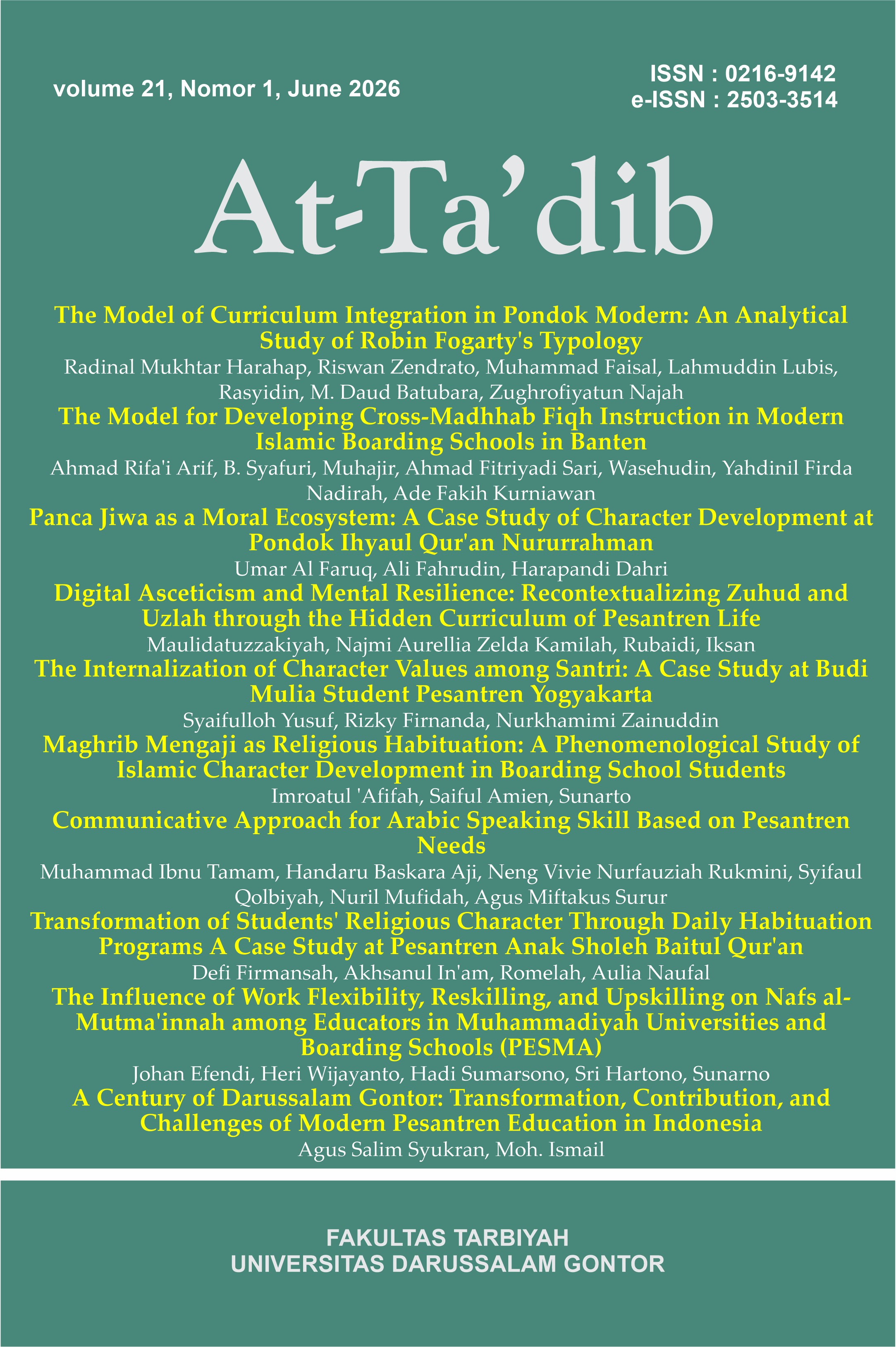
Communicative Approach for Arabic Speaking Skill Based on Pesantren Needs
DOI:
https://doi.org/10.21111/at-tadib.v21i1.20Keywords:
communicative approach, arabic, speaking skill, pesantren, pedagogy.Abstract
Arabic speaking instruction in pesantren is often constrained by a grammar-centered paradigm that limits learners’ communicative competence despite Arabic’s functional role in daily religious and educational practices. Purpose: This study aims to construct a communicative language teaching design for Arabic speaking skills based on pesantren needs, drawing on Finochairo and Brumfit’s communicative framework. Methods: A qualitative research design employing a systematic literature review was conducted. Data were collected through staged identification, screening, and critical analysis of scholarly sources, including books and peer-reviewed articles, and analyzed using descriptive-interpretive techniques. Findings: The study identifies six pedagogical procedures for communicative Arabic instruction: presentation of short dialogues, oral drills, question–answer practice, contextual Arabic expression discussion, rule awareness, and performance-based evaluation. These procedures collectively emphasize meaning-oriented interaction, fluency development, and contextualized language use within pesantren environments. Implications: The proposed model offers a structured communicative framework for Arabic speaking instruction in pesantren, though its applicability remains conceptual and requires empirical validation across diverse institutional settings. Originality: This study synthesizes Finochairo and Brumfit’s communicative theory into a pesantren-specific instructional design, contributing a context-sensitive model for Arabic speaking pedagogy.
References
Akmalia, Frida, Syihabuddin Syihabuddin, and Yayan Nurbayan. “Intensive Course: The Alternative Program for Teaching Arabic Speaking and Reading Skills at an Islamic Boarding School/al-Daurah al-Mukatsafah: Al-Barnamij al-Badil Li Ta’lim Maharah al-Kalam Wa al-Qira’ah Fi al-Ma’had.” Arabiyatuna : Jurnal Bahasa Arab 5, no. 1 (2021): 113. https://doi.org/10.29240/jba.v5i1.2306.
Eisenring, Mohammad Abraham Akbar, and Margana Margana. “THE IMPORTANCE OF TEACHER – STUDENTS INTERACTION IN COMMUNICATIVE LANGUAGE TEACHING (CLT).” PRASASTI: Journal of Linguistics 4, no. 1 (2019): 1. https://doi.org/10.20961/prasasti.v4i1.17052.
Finocchiaro, Mary, and Christopher Brumfit. The Functional-Notional Approach: From Theory to Practice. Oxford University Press, 1983.
Fitri, Titi, Bilqis Arifah, Shofil Fikri, and Hakmi Hidayat. “BAHASA, PENDIDIKAN, DAN AGAMA DALAM PEMBELAJARAN BAHASA ARAB.” Lahjah Arabiyah: Jurnal Bahasa Arab Dan Pendidikan Bahasa Arab 6, no. 1 (2025): 38–54. https://doi.org/10.35316/lahjah.v6i1.38-54.
Haron, Sueraya Che. “The Teaching Methodology of Arabic Speaking Skills: Learners’ Perspectives.” International Education Studies 6, no. 2 (2012): 2. https://doi.org/10.5539/ies.v6n2p55.
Hasan, Hasan. “Peran Lingkungan Bahasa (Language Environment) Dalam Penguasaan Bahasa Arab Di Lembaga Pendidikan.” Pelita: Jurnal Studi Islam Mahasiswa UII Dalwa 1, no. 2 (2024): 216–25. https://doi.org/10.38073/pelita.v1i2.1842.
Lara Velarde, Adriana Carolina, Jessica María Guaranga Lema, Mayra Jacqueline Iguasnia Guala, and Jhon Jairo Inca Guerrero. “Communicative activities to enhance oral production in the EFL classroom.” Ciencia Digital 6, no. 1 (2022): 6–26. https://doi.org/10.33262/cienciadigital.v6i1.1952.
Luz, Fredson da. “The Relationship between Teachers and Students in the Classroom: Communicative Language Teaching Approach and Cooperative Learning Strategy to Improve Learning.” Master’s Theses and Projects, May 1, 2015. https://vc.bridgew.edu/theses/22.
M. Hadi Sutiyo. “Peran Kompetensi Bahasa Arab Dalam Meningkatkan Pemahaman Mendalam Santri Terhadap Al-Qur’an Dan Hadits.” Akademika: Jurnal Manajemen Pendidikan Islam 6, no. 2 (2024): 280–95. https://doi.org/10.51339/akademika.v6i2.3088.
Minatullah, Minatullah, Ahmad Fatoni, and Anisatu Thoyyibah. “Implementation of Communicative Method as an Effort to Increase the Student’s Arabic Language Ability (Case Study at SDI Surya Buana Malang).” Maharaat: Jurnal Pendidikan Bahasa Arab 2, no. 1 (2019): 1. https://doi.org/10.18196/mht.2115.
Muradi, Ahmad. “PENDEKATAN KOMUNIKATIF DALAM PEMBELAJARAN BAHASA ARAB.” ARABIYAT: Jurnal Pendidikan Bahasa Arab dan Kebahasaaraban 1, no. 1 (2014): 29–48. https://doi.org/10.15408/a.v1i1.1129.
Pane, Akhiril. “URGENSI BAHASA ARAB; BAHASA ARAB SEBAGAI ALAT KOMUNIKASI AGAMA ISLAM.” Komunikologi: Jurnal Pengembangan Ilmu Komunikasi Dan Sosial 2, no. 1 (2018). https://doi.org/10.30829/komunikologi.v2i1.5452.
Ramadhanti, Suci, Desriliwa Ade Mela, Refiyana Yolanda, et al. DINAMIKA PEMBELAJARAN BAHASA ARAB DI INDONESIA Masa Kolonial hingga Masa Modern. 1st ed. Literasi Nusantara Abadi Grup, 2025.
Richards, Jack C. Curriculum Development in Language Teaching. Cambridge University Press, 2001.
Rohmah, Marfiatu. “Implementasi Kegiatan Ekstrakurikuler Muhadharah dalam Meningkatkan Motivasi dan Percaya Diri Santri Putri Pondok Pesantren Darul A’Mal Metro.” Masters, IAIN Metro, 2025. https://repository.metrouniv.ac.id/id/eprint/11127/.
Salam, Muhammad Yusuf, and Yovan Luksfinanto. “A Comprehensive Review of Communicative Language Teaching (CLT) in Modern Classrooms.” Lingeduca: Journal of Language and Education Studies 3, no. 1 (2024): 58–70. https://doi.org/10.70177/lingeduca.v3i1.1338.
Setyosari, Punaji. Desain Pembelajaran. Bumi Aksara, 2020.
Tamam, Muhammad Ibnu, Nuril Mufidah, Abdul Wahab Rosyidi, Ruhamaul Waro, Rahmania Auriel Zaeni, and Alfiyah Firdausi Nuzula. “Applying Kitab ‘Abbir Lughataka! Based on Communicative Approach in Muhādatsah Usbū’Iyyah Program at Pesantren Daarul Uluum Bogor.” AL-WIJDÃN Journal of Islamic Education Studies 10, no. 2 (2025): 403–23.
Tamam, Muhammad Ibnu, Abdul Wahab Rosyidi, Nuril Mufidah, and Neng Vivie Nurfauziah Rukmini. “Desain buku panduan muhadatsah berbasis pendekatan komunikatif untuk santri di Pesantren Daarul Uluum Bantarkemang Bogor.” Tawazun: Jurnal Pendidikan Islam 18, no. 1 (2025): 167–92. https://doi.org/10.32832/tawazun.v18i1.19142.
Tampubolon, Muhammad Syafii, and Rahmad Ilahi. “IMPLEMENTATION OF COMMUNICATIVE APPROACH IN MUHADATSAH LEARNING IN THE DIGITAL ERA.” Thariqah Ilmiah: Jurnal Ilmu-Ilmu Kependidikan & Bahasa Arab 13, no. 1 (2025): 1–16. https://doi.org/10.24952/thariqahilmiah.v13i1.13789.
Zahra Atika Mappiara, Muh Arif, Mikhtar I Miolo, and Suleman D. Kadir. “Isu Dan Problematika Dalam Pembelajaran Maharah Kalam.” AL-KILMAH 2, no. 1 (2023): 48–61. https://doi.org/10.58194/alkilmah.v2i1.1847.
Zaid, Abdul Hafidz. “Pendekatan Komunikatif Dalam Pengajaran Bahasa Arab (Pengalaman Pondok Modern Darussalam Gontor).” At-Ta’dib 7, no. 2 (2012): 2. https://doi.org/10.21111/at-tadib.v7i2.77.
Zed, Mestika. Metode Penelitian Kepustakaan. Yayasan Pustaka Obor Indonesia, 2008.
Downloads
Submitted
Accepted
Published
How to Cite
Issue
Section
License
Copyright (c) 2026 At-Ta'dib

This work is licensed under a Creative Commons Attribution-NonCommercial-ShareAlike 4.0 International License.