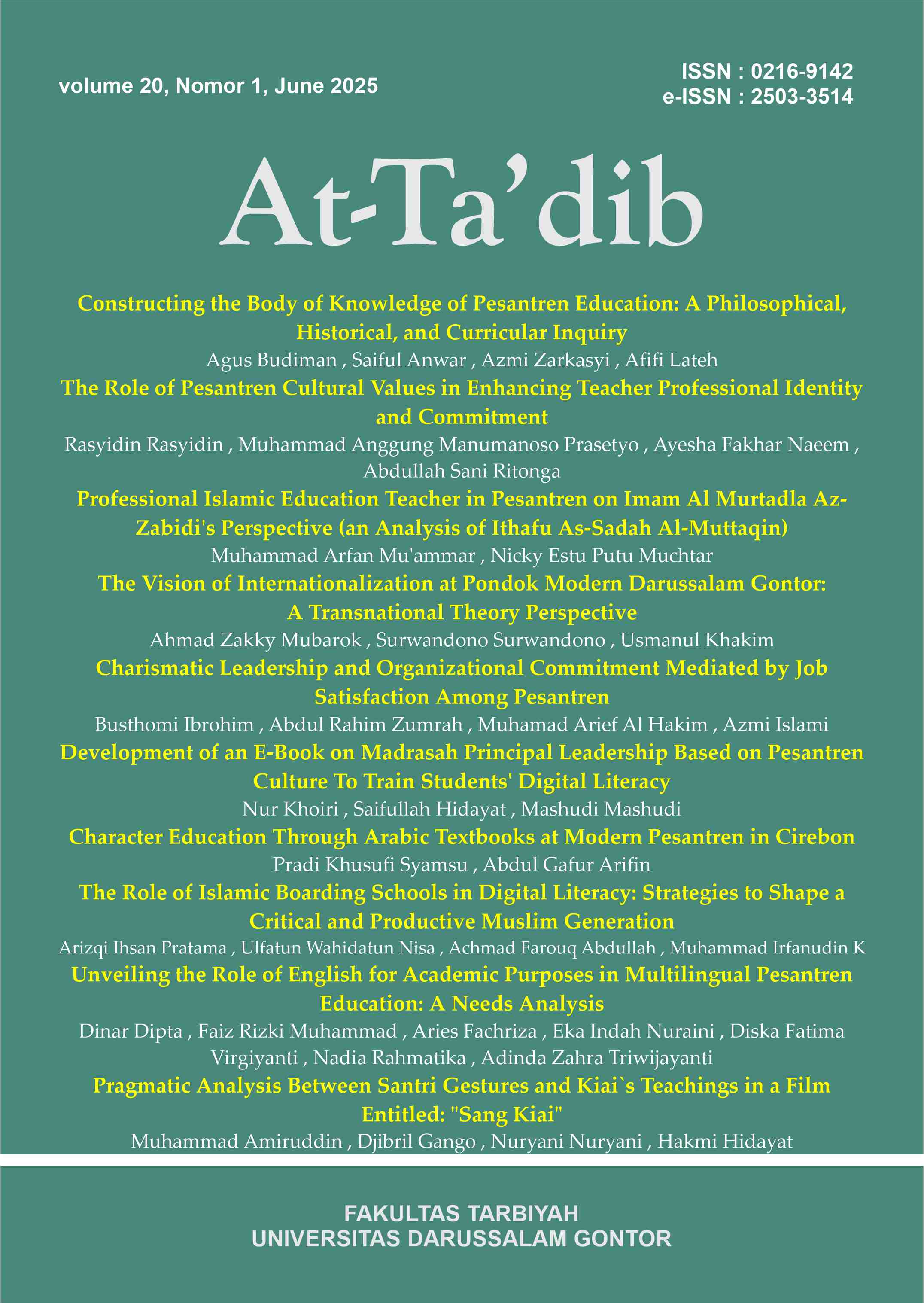
Unveiling the Role of English for Academic Purposes in Multilingual Pesantren Education: A Needs Analysis
DOI:
https://doi.org/10.21111/at-tadib.v20i1.34Keywords:
Academic Empowerment; English for Academic Purposes; Multilingual Education in Pesantren; Needs Analysis.Abstract
Purpose - Pesantren, as Indonesia’s longstanding Islamic boarding schools, have traditionally prioritized Arabic for religious instruction. However, in response to global academic demands, many pesantren are now adopting multilingual approaches, including the integration of English for Academic Purposes (EAP). This study aims to analyze the specific linguistic needs of pesantren students to inform the design of EAP curricula tailored to multilingual Islamic education contexts. Methods - Employing a descriptive qualitative ethnographic method, the research collected data through semi-structured interviews, questionnaires, and observations involving 30 randomly selected university students and institutional stakeholders in an East Java pesantren. Findings – The findings reveal that multilingualism in pesantren fosters cognitive flexibility, intercultural competence, and religious-literacy development, but it also presents substantial challenges for acquiring academic English proficiency. Research implications / limitations -This study highlights the importance of conducting rigorous needs analysis for EAP course design in pesantren and offers practical insights for improving curriculum design, language policy, and teacher preparation. Limitations include the contextual focus on a single pesantren university and the absence of a comparative multilingual education model.Originality - The study’s originality lies in its integration of EAP with Islamic multilingual education, a combination underexplored in current literature. It provides a framework for enhancing pesantren students' academic readiness in both local and global contexts.
Downloads
Submitted
Published
How to Cite
Issue
Section
License
Copyright (c) 2026 At-Ta'dib

This work is licensed under a Creative Commons Attribution-NonCommercial-ShareAlike 4.0 International License.