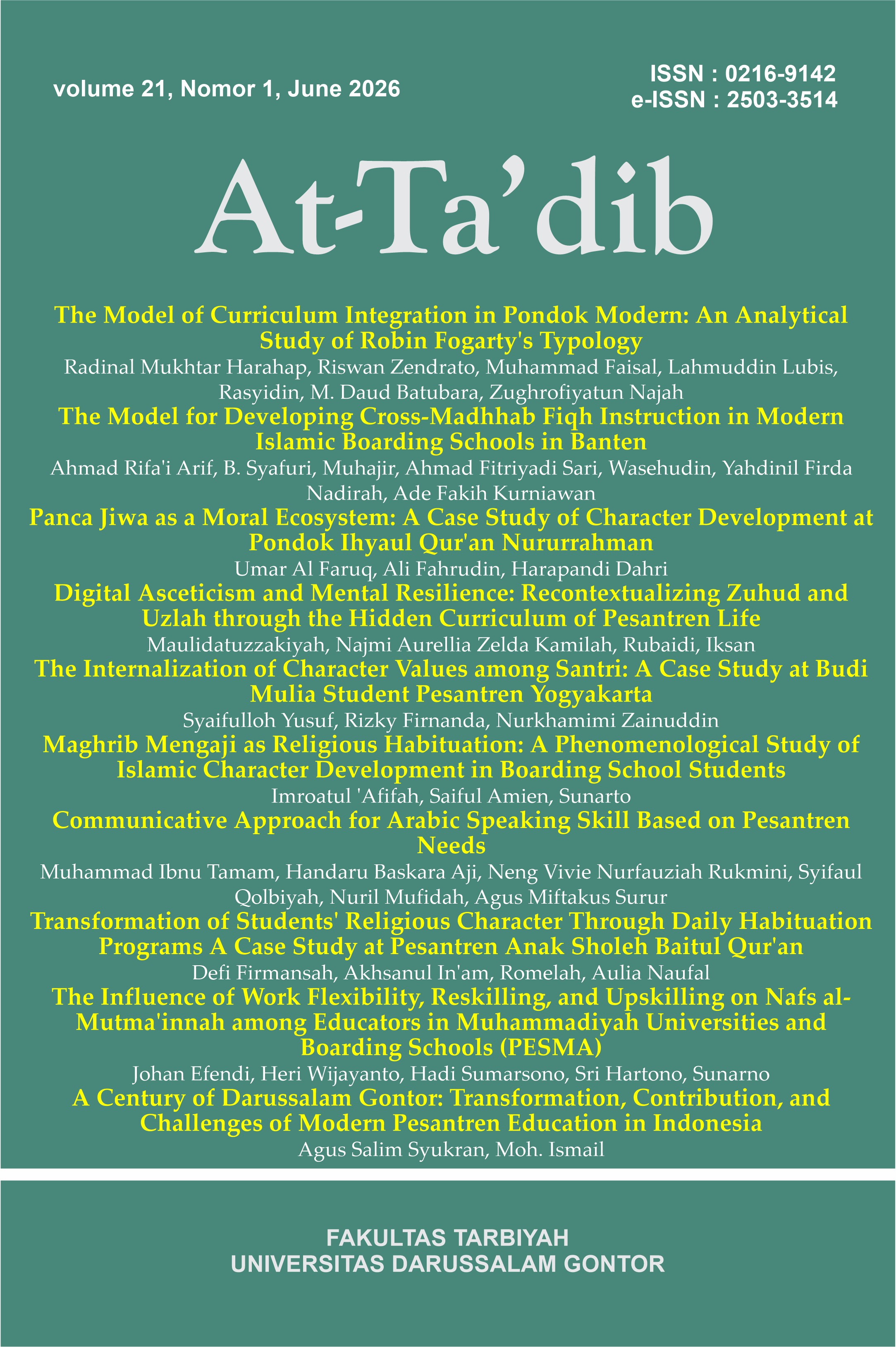
The Model for Developing Cross-Madhhab Fiqh Instruction in Modern Islamic Boarding Schools in Banten
DOI:
https://doi.org/10.21111/at-tadib.v21i1.19Keywords:
Learning Model, Cross-School Jurisprudence, Modern Islamic Boarding School.Abstract
Dominant mono-madhhab fiqh instruction in Islamic boarding schools often constrains epistemic plurality and limits students’ interpretive literacy in Islamic legal reasoning. This pedagogical reductionism necessitates a more integrative and methodologically plural instructional framework. Purpose: This study develops a cross-madhhab fiqh learning model for modern Islamic boarding schools in Banten grounded in the Kulliyatul Mu‘allimin al-Islamiyyah (KMI) system and aligned with contemporary instructional design principles. Methods: A Research and Development design was employed using the Dick and Carey model. Data were obtained through needs analysis, observation, interviews, documentation, expert validation, and field testing, and analyzed using mixed qualitative and quantitative procedures including pre-test/post-test gain analysis. Findings: Results indicate that existing fiqh instruction remains predominantly textual and single-school oriented. The proposed model integrates fiqh muqāran, maqāṣid al-sharī‘ah, and Problem-Based Learning within a Baḥth al-Masā’il syntax, utilizing classical comparative texts. Empirical testing demonstrates improved students’ comprehension of jurisprudential plurality and significant enhancement of moderate and dialogical dispositions. Implications: The model provides a scalable instructional framework for modern pesantren, although external validity remains limited to selected institutions in Banten, requiring broader contextual replication. Originality: This study advances a hybrid pedagogical architecture that synthesizes classical Islamic jurisprudence epistemology with systematic instructional design theory.
References
Ahmad Fitriyadi Sari, Encep Syarifudin, and Muhajir. “The Relationship Between Learning Process Management and Improving Santri’s Life Skills at Darunna’im Islamic Boarding School in Lebak Regency.” JMKSP (Jurnal Manajemen, Kepemimpinan, dan Supervisi Pendidikan) 8, no. 1 (2023).
Ahmadiono, Ahmadiono, Fathor Rahman, and Fawaizul Umam. “Strengthening Religious Moderation through Revitalizing Ma’had Al-Jami’ah: A Case Study in State Islamic Higher Education.” Al-Tahrir: Jurnal Pemikiran Islam 25, no. 1 (2025): 1–24.
Creswell, John W., and J. David Creswell. Mixed Methods Procedures. Research Design: Qualitative, Quantitative, and Mixed Methods Approaches, 2018.
Daud, Muslem, Bor-Chen Kuo, Jamaluddin Jamaluddin, Muhammad Duskri, Cut Morina Zubainur, and Jalaluddin Jalaluddin. “Assessing the Effectiveness of CAT and MCAT in Measuring Students’ Understanding in Technology Education.” At-Ta’dib 19, no. 1 (2024): 117–132.
Dian, Dian, Anggun Dewi, Wafiq Fadhilah Anwar, and Muhamad Deden Jalaludin Sayuti. “Implementation of Segmentation, Targeting and Positioning of Islamic Education Institutions.” At-Ta’dib 19, no. 1 (2024): 17–29.
H. B. Syafuri, and Muhamad Wahyudin. “The Purpose of Law in the Study of Legal Philosophy.” Formosa Journal of Sustainable Research 1, no. 6 (2022).
Hanafiah, Hanafiah, Kushariyadi Kushariyadi, Wakhudin Wakhudin, B Rukiyanto, Iwan Usma Wardani, and Anuar Ahmad. “Dampak Pendidikan Karakter Terhadap Kepribadian Siswa: Tinjauan Kurikulum Dan Praktik Sekolah.” At-Ta’dib 19, no. 1 (2024).
Honeyman, Catherine, Laura Cordisco Tsai, Nancy Chervin, Melanie Sany, and Janice Ubaldo. “Workforce Skills Curriculum Development in Context: Case Studies in Rwanda, Algeria, and the Philippines,” 2022.
Kirom, Makhiulil. “Barikan, Islamic Values and Social-Religious Life Integration: A Living Quran and Hadith Study.” Al-Tahrir: Jurnal Pemikiran Islam 25, no. 1 (2025): 41–56.
Kurniawan, Ade Fakih, Arif Rahman, Mukhsin Achmad, and Fahmi Rizki Fahroji. “Young Muslim Clicktivism and Religious Local Tradition Discourse in Banten and Yogyakarta.” Millah: Journal of Religious Studies 21, no. 3 (2022).
Louis Cohen, Lawrence Manion and Keith Morrison. Research Methods in Education. 8th editio. New York: Routledge, 2018.
Mahmudi, Ihwan, Neni Naqiyah, and Alif Cahya Setiyadi. “The Influence Of High Order Thinking Skill (Hots) Based Questions On Arabic Language Learning Outcomes Of Madrasah Tsanawiyah Student.” At-Ta’dib 18, no. 2 (2024): 49–70.
Munadi, Muhammad, Fetty Ernawati, and Hakiman Hakiman. “The Reality of Knowledge Management in Islamic Higher Education.” Jurnal Pendidikan Islam 7, no. 2 (2019).
Munastiwi, Erni, and Marfuah Marfuah. “Islamic Education in Indonesia and Malaysia: Comparison of Islamic Education Learning Management Implementation.” Jurnal Pendidikan Islam 8, no. 1 (2019).
Nicolas, Djone Georges, Timothy Amien Rk., Soneta Sang Surya Siahaan, Iwan Ramadhan, and Lilik Huriyah. “Implementasi Metode Pembelajaran Experiential Learning Untuk Meningkatkan Akademik Santri Sma Pondok Pesantren.” At-Ta’dib 18, no. 2 (2024): 113–136.
Sahri, Sahri. “The Concept Of Education Management In The Post-Conflict Regions Of West Kalimantan: A Study Of Ibn Khaldun’s Thought.” At-Ta’dib 18, no. 2 (2024): 1–26.
Saniah, Lia, Melinda Putri Mubarika, and Wati Irnawati. “Implementation Of An E-Learning Media Management Strategy In The Improvement Of The Learning Performance Of Mathematics In Private Universities.” At-Ta’dib 19, no. 1 (2024): 133–153.
Sari, Ahmad Fitriyadi. “The Role of Parents in Building Spiritual, Moral, and Intellectual Mentality in Children.” Journal of Childhood Development 3, no. 1 (2023).
Sari, Ahmad Fitriyadi, Ilzamudin Ilzamudin, Rumbang Sirojuddin, and Mamat Rahmatullah. “Academic Culture, Leadership, and Islamic Motivation as Predictors of Lecturer Performance: Evidence from an Indonesian Pesantren.” Journal of Asian Islamic Educational Management (JAIEM) 3, no. 1 (2025).
Setyaningsih, Rina. “Membangun Character Building Peserta Didik Mts Hidayatul Mubtadiin Dan Relevasinya Bagi Pengembangan Pendidikan Agama Islam.” At-Ta’dib 19, no. 1 (2024): 93–116.
Suhail, Ahmad Kusjairi, Daud Lintang, Ade Pahrudin, and Willy Oktaviano. “Azyurmardi Azra Dan Moderasi Beragama Di Indonesia.” Al Qalam: Jurnal Ilmiah Keagamaan dan Kemasyarakatan 19, no. 2 (2025).
Syafe’i, H.B. Syafuri, and Yus’aini. “Manajemen Kurikulum Dalam Peningkatan Mutu Pendidikan Kesetaraan Tingkat Wustho Pada Pondok Pesantren At-Thohariyah Sodong Pandeglang.” Formosa Journal of Social Sciences (FJSS) 1, no. 2 (2022).
Tahir, Gustia. “Religious Moderation of Millennial Generation At Islamic Higher Education in Eastern Indonesia” .Al-Tahrir 23, no. 2 (2023): 293–325.
Zaman, Akhmad Qomaru, Dwi Retnani Srinarwati, and Suhari Suhari. “Leadership Model of Pesantren The Counteract of Religious Blasphemy Movement In Indonesia.” At-Ta’dib 18, no. 2 (2024): 209–230.
Zunaidi, Arif, Fachrial Lailatul Maghfiroh, and Nurul Athirah Mohd Azmi. “Fatwas, Religious Moderation, and Global Security: Examining the Intersection of Islamic Economic Jihad and Humanitarian Responses to the Israel-Palestine Conflict.” Al-Tahrir: Jurnal Pemikiran Islam 25, no. 1 (2025): 73–90.
Downloads
Submitted
Accepted
Published
How to Cite
Issue
Section
License
Copyright (c) 2026 At-Ta'dib

This work is licensed under a Creative Commons Attribution-NonCommercial-ShareAlike 4.0 International License.