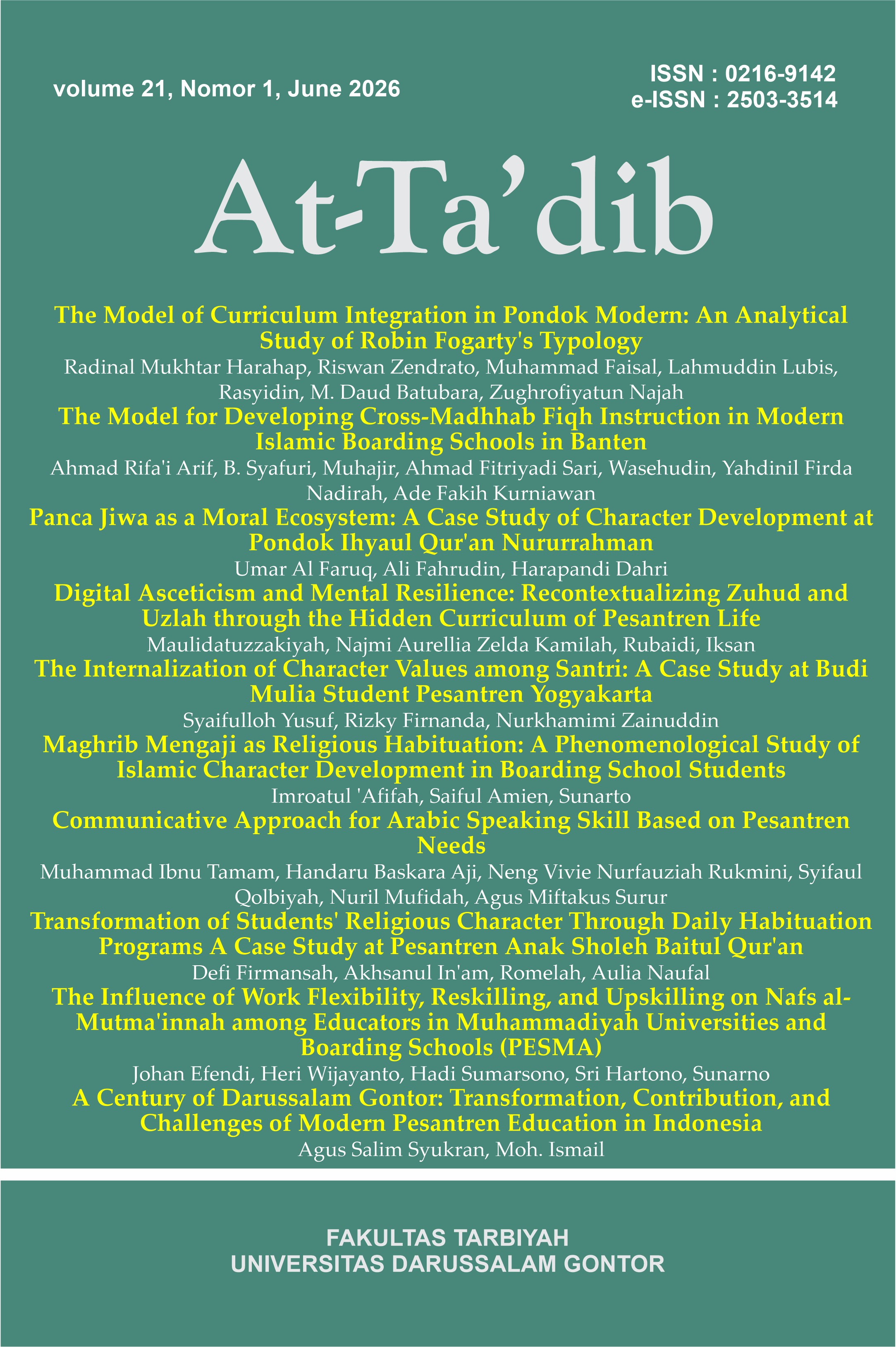
Transformation of Students’ Religious Character Through Daily Habituation Programs A Case Study at Pesantren Anak Sholeh Baitul Qur’an
DOI:
https://doi.org/10.21111/at-tadib.v21i1.12Kata Kunci:
Transformation, education, religious character, daily habituation, pesantren.Abstrak
Although daily habituation has been widely recognized as an effective approach to character education, limited research has explained how continuous habituation within a 24-hour pesantren environment transforms students’ religious character from externally regulated behavior into internally grounded religious consciousness. Purpose: This study aims to analyze the role of daily habituation practices in transforming students’ religious character at MI Pesantren Anak Sholeh Baitul Qur’an. Methods: A qualitative case study was conducted through participant observation, in-depth interviews, and document analysis involving school leaders, teachers, caregivers, and students. Data were analyzed using thematic analysis based on the interactive model of Miles and Huberman. Findings: The findings reveal that daily habituation functions as a holistic pedagogical mechanism integrating worship, religious learning, moral practice, discipline, and independence within the pesantren’s continuous educational environment. Religious character develops gradually through repeated practices, role modelling, hidden curriculum, and communal life, transforming students from rule-based compliance into sincere religious awareness accompanied by responsibility, self-discipline, independence, and social morality. Implications: These findings offer a practical framework for sustainable religious character education in Islamic schools, although the study is limited to a single pesantren-based elementary institution. Originality: This study conceptualizes daily habituation as a transformative pedagogical model that integrates cognitive, affective, behavioral, and spiritual dimensions within a holistic 24-hour pesantren ecosystem.
Referensi
Aeni, Aini Nur. “Pendidikan Karakter Untuk Siswa SD Dalam Perspektif Islam.” Mimbar Sekolah Dasar 1, no. 1 (2014): 50–58.
Al-Mahfani, Khalid. Dahsyatnya Do’a Pagi. Jakarta: Wahyu Media, 2013.
Badriyah, Fina, Akmal Hawi, and Muhammad Fauzi. “KONSEP 4 M (MENGETAHUI, MENCINTAI, MENGINGINKAN, MENGERJAKAN) PENDIDIKAN KARAKTER PERSPEKTIF RATNA MEGAWANGI DAN RELEVANSINYA DALAM MENCIPTAKAN AKHLAK (STUDI KASUS DI MTs N 1 PALEMBANG).” Jurnal PAI Raden Fatah 3, no. 2 (2021): 152–65. https://doi.org/10.19109/pairf.v3i2.6396.
Bandura, Albert. Social Foundations of Thought and Action: A Social Cognitive Theory. Englewood Cliffs, NJ: Prentice-Hall, 1986.
Dhofier, Zamakhsyari. Tradisi Pesantren: Studi Tentang Pandangan Hidup Kyai. Jakarta: LP3ES, 2011.
Forbes, Scott H. Holistic Education: An Analysis of Its Ideas and Nature. Brandon, VT: Foundation for Educational Renewal, 2003.
Jackson, Philip W. Life in Classrooms. New York: Holt, Rinehart and Winston, 1968.
Jannah, Miftahul. “Pendidikan Karakter Pada Sekolah Dasar Di Pondok Pesantren Dalam Pembentukan Kedisiplinan, Tanggung Jawab, Dan Kemandirian Siswa” 2, no. 2 (2018): 21–42.
Kemendikbud. “Modul Pelatihan Pendidikan Karakter Bagi Guru,” 2017, 50.
Lickona, T. Educating for Character: How Our Schools Can Teach Respect and Responsibility. New York: Bantam Books, 2013.
Mathew B. Milles, A. Michael Hubberman. Qualitative Data Analysis. London: SAGE Publications, 1994.
Miller, Jack. Why the Holistic Curriculum? Holistic Education Review. Vol. 1, 1988.
Naldi, Anri, Lahmuddin Lubis, and Nurmawati Nurmawati. “Reward and Punishment as Learning Motivation at Mts.S Al-Wasliyah Deli Serdang Regency.” SYAMIL: Jurnal Pendidikan Agama Islam (Journal of Islamic Education) 12, no. 2 (2024): 457–82. https://doi.org/10.21093/sy.v12i2.9916.
Opić, Siniša, and Marina Đuranović. “Leisure Time of Young Due to Some Socio-Demographic Characteristics.” Procedia - Social and Behavioral Sciences 159 (2014): 546–51. https://doi.org/10.1016/j.sbspro.2014.12.422.
Podungge, Mariaty. “Pembentukan Karakter Student Melalui Pembiasaan Kegiatan Harian Di Pondok Pesantren Khairul Hikmah” 8, no. 2 (2025): 484–98.
Robbaniyah, Qiyadah, and Roidah Lina. “Internalisasi Budaya Pesantren Dalam Penguatan Karakter Student Pondok Pesantren ICBB Yogyakarta.” Amorti: Jurnal Studi Islam Interdisipliner 2, no. 2 (2023): 108–18. https://doi.org/10.59944/amorti.v2i2.94.
Sugiyono. Metode Penelitian Kuantitatif, Kualitatif, Dan R&D. Bandung: Alfabeta, 2013.
Suroso, Suroso, and Farida Husin. Analyzing Thomas Lickona’s Ideas in Character Education (A Library Research). Atlantis Press SARL, 2024. https://doi.org/10.2991/978-2-38476-220-0_5.
Wibowo, Agus. Pendidikan Karakter: Strategi Membangun Karakter Bangsa Berperadaban. Yogyakarta: Pustaka Pelajar, 2013.
Unduhan
Telah diserahkan
Diterima
Diterbitkan
Cara Mengutip
Terbitan
Bagian
Lisensi
Hak Cipta (c) 2026 At-Ta'dib

Artikel ini berlisensiCreative Commons Attribution-NonCommercial-ShareAlike 4.0 International License.