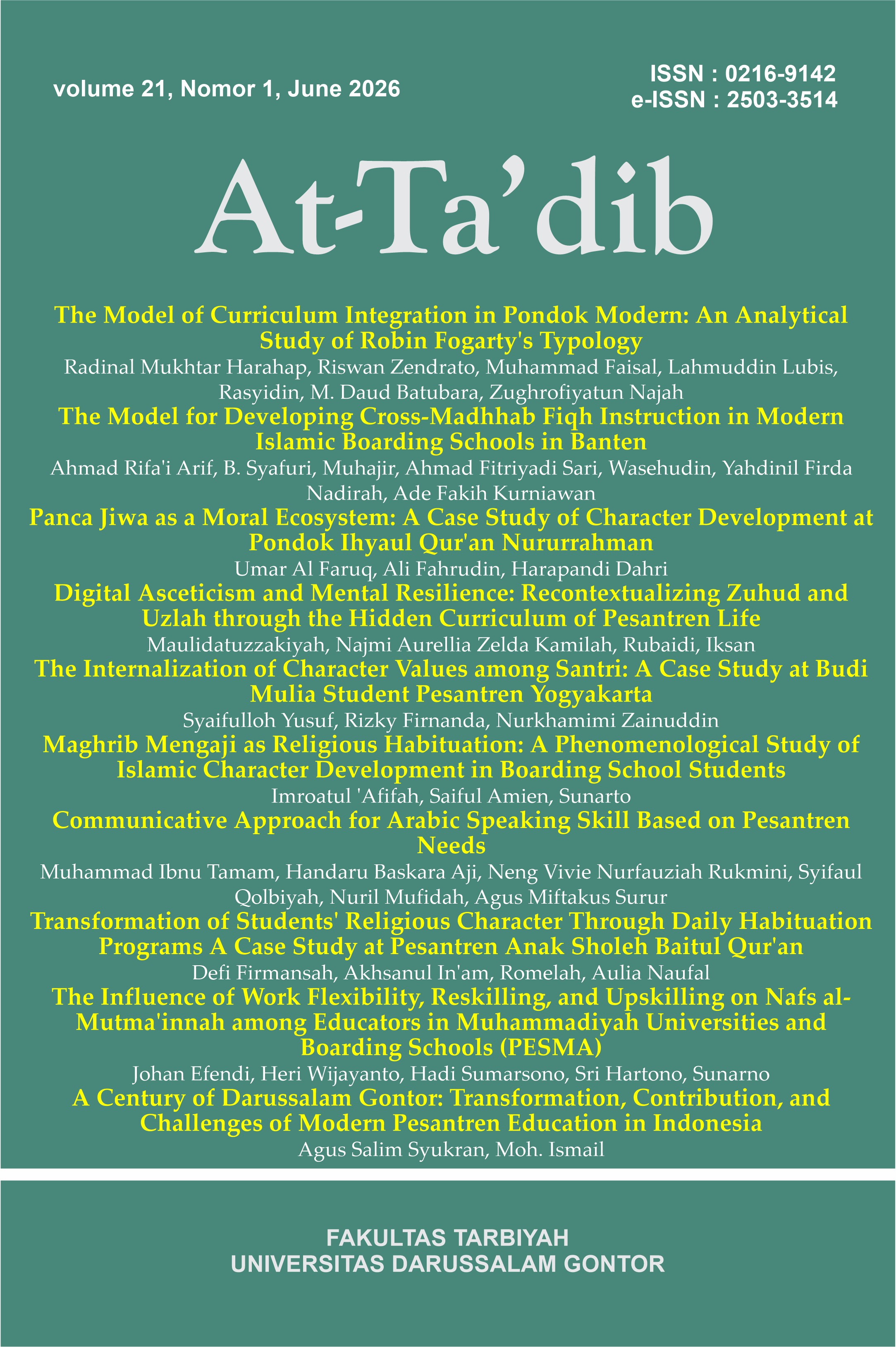
Digital Asceticism and Mental Resilience: Recontextualizing Zuhud and Uzlah through the Hidden Curriculum of Pesantren Life
DOI:
https://doi.org/10.21111/at-tadib.v21i1.23الكلمات المفتاحية:
digital asceticism, mental resilience, zuhud and uzlah, hidden curriculum, pesantren.الملخص
Digital asceticism remains under-theorized despite growing concerns over emotional dependency on digital environments, while Islamic concepts such as zuhud and uzlah are still largely treated as normative constructs rather than lived educational practices. Purpose: This study examines how these values are recontextualized as digital asceticism through the hidden curriculum at Pondok Pesantren Babussalam, an Islamic boarding school in Jombang. Methods: A qualitative phenomenological design was employed involving ten female santri and three key informants selected purposively. Data were collected through semi-structured interviews, participant observation, and document analysis over 120 hours of fieldwork, and analyzed using reflexive thematic analysis with iterative coding and triangulation. Findings: Five interrelated themes emerged: zuhud as detachment from digital validation, uzlah as structured routine-based withdrawal, internalization of self-regulation via hidden curriculum practices, emerging mental resilience against digital overstimulation, and rebound effects during periods of unrestricted access. Findings indicate that spiritual routines, role modeling, and peer-based habituation transform external restrictions into internalized self-regulation. Implications: Digital asceticism functions as a pedagogical mechanism for cultivating self-control and resilience, although findings are context-specific and require further cross-institutional validation. Originality: This study advances a phenomenological-theological framework linking classical Islamic ethics with digital behavior regulation through the hidden curriculum in pesantren education.
المراجع
Abitolkha, Amir Maliki, Taufik Alamin, Nur Hadi Ihsan, and Melania Sarah Huwaida. ‘Balanced Engagement: Kiai Ihsan Jampes’ Adaptive Zuhud Framework for Spiritual Transformation in the Digital Era’. QIJIS (Qudus International Journal of Islamic Studies) 13, no. 1 (2025): 39–80. https://doi.org/10.21043/qijis.v13i1.22322.
Aldbyani, Aamer, Guiyun Wang, Zhang Chuanxia, and Afnan Alhimaidi. ‘Dispositional Mindfulness Is Associated with Lower Smartphone Addiction through Digital Life Balance among Chinese University Students’. Frontiers in Psychology 16 (October 2025): 1653620. https://doi.org/10.3389/fpsyg.2025.1653620.
Al-Ghazali. Ihya Ulum Al-Din. Vol. 4. Dar al-Kutub al-Ilmiyyah, 2011.
Alhamuddin, Alhamuddin, Andi Murniati, and Norhayati Yahaya. ‘Bridging Faith and Knowledge: Reframing Holistic Islamic Education for Integrity-Based Character Formation’. At-Ta’dib 20, no. 2 (2025). https://doi.org/https://doi.org/10.21111/at-tadib.v20i2.37.
Aryal, Rachana, Gunnhild Johnsen Hjetland, Ellen Haug, Oddrun Samdal, and Jens Christoffer Skogen. ‘Online Personas: Associations Between Focus on Self-Presentation and Social Comparison on Social Media and Mental Well-Being in Early Adolescence’. International Journal of Public Health 70 (April 2025): 1608425. https://doi.org/10.3389/ijph.2025.1608425.
Bourdieu, Pierre. The Logic of Practice. Translated by Richard Nice. Stanford University Press, 1990.
Braun, Virginia, and Victoria Clarke. Thematic Analysis: A Practical Guide. Sage, 2022.
Castelo, Noah, Kostadin Kushlev, Adrian F. Ward, Michael Esterman, and Peter B. Reiner. ‘Blocking Mobile Internet on Smartphones Improves Sustained Attention, Mental Health, and Subjective Well-Being’. PNAS Nexus 4, no. 2 (2025): pgaf017. https://doi.org/10.1093/pnasnexus/pgaf017.
Dekker, Cynthia A., Susanne E. Baumgartner, Sindy R. Sumter, and Jakob Ohme. ‘Beyond the Buzz: Investigating the Effects of a Notification-Disabling Intervention on Smartphone Behavior and Digital Well-Being’. Media Psychology 28, no. 1 (2025): 162–88. https://doi.org/10.1080/15213269.2024.2334025.
Fendel, Johannes C., Johannes J. Bürkle, and Stefan Schmidt. ‘The Relationship between Trait Mindfulness and Problematic Usage of the Internet, Screen Time, and Nomophobia: A Systematic Review and Meta-Analysis’. Journal of Behavioral Addictions 14, no. 2 (2025): 590–610. https://doi.org/10.1556/2006.2025.00052.
Halid, Ahmad. ‘Hidden Curriculum Pesantren: Urgensi, Keberadaan Dan Capaiannya’. Tarbiyatuna: Jurnal Pendidikan Islam 12, no. 2 (2019): 140. https://doi.org/10.36835/tarbiyatuna.v12i2.398.
Harahap, Nurhanipah. ‘Studi Filosofis Terhadap Konsep Zuhud Dan Tazkiyah An-Nafs Dalam Kehidupan Kontemporer’. Academic Journal of Islamic Principles and Philosophy 6, no. 2 (2025). https://doi.org/10.22515/ajipp.v6i2.12635.
Harnadi, Dodik, Hotman Siahaan, and Masdar Hilmy. ‘Pesantren and the Preservation of Traditional Religious Authority in the Digital Age’. Masyarakat, Kebudayaan Dan Politik 34, no. 3 (2021): 272–80. https://doi.org/10.20473/mkp.V34I32021.272-280.
Ihsan, Nur Hadi, Kholid Karomi, Zalfaa’ ’Afaaf Zhoofiroh, and Deden Ruhiat Mubarok. ‘Islamic Spirituality and Fear of Missing Out (FOMO): Revisiting ‘Uzlah in the Thought of Sheikh Nawawi al-Bantani’. Kalam 19, no. 1 (2025): 83–104. https://doi.org/10.24042/202519122271.
Insyirah, Yeni, Muthoifin Muthoifin, and Triono Ali Mustofa. ‘Educational Intervention on Character Gradation of Digital Muslim Adolescents According to Al-Qur’an Surah Adz-Dzariyat Verse 56.’ At-Ta’dib 18, no. 1 (2023): 43–55. https://doi.org/10.21111/attadib.v18i1.9906.
Islami, Devi Rahma, Faatimatuzzahro, Ainnaya Faatihah, and Tsaniatus Soraya. ‘Strategi Group Discussion Untuk Meningkatkan Kemampuan Berpikir Kritis Santri Pondok Pesantren’: Jurnal Kolaboratif Sains 8, no. 12 (2025): 9036–40. https://doi.org/https://doi.org/10.56338/jks.v9i1.9685.
Kolhe, Durgeshwary, and Abdul Raffie Naik. ‘Digital Detox as a Means to Enhance Eudaimonic Well-Being’. Frontiers in Human Dynamics 7 (July 2025): 1572587. https://doi.org/10.3389/fhumd.2025.1572587.
Krishnamurthy, Kandamaran, Ambadasu Bharatha, Snehal Mehta, et al. ‘Navigating the Digital Dilemma: Internet and Smartphone Addiction among Children and Adolescents’. Advances in Human Biology 16, no. 1 (2026): 20–30. https://doi.org/10.4103/aihb.aihb_53_25.
Lave, Jean, and Etienne Wenger. Situated Learning: Legitimate Peripheral Participation. 1st edn. Cambridge University Press, 1991. https://doi.org/10.1017/CBO9780511815355.
Lincoln, Yvonna S., and Egon G. Guba. Naturalistic Inquiry. Sage Publications, 1985.
Nasution, Suryadi, Ali Jusri Pohan, Khairurrijal, Kholidah Nur, and Zelly Putriani. ‘Empowering Santri Well-Being: Integrating Spiritual Practices and SEL in Pesantren Mental Health’. Cendekia: Jurnal Kependidikan Dan Kemasyarakatan 23, no. 1 (2025): 121–41. https://doi.org/10.21154/cendekia.v23i1.10526.
Wafa, Salamah Sa’diatul, Nurul Iman, Katni Katni, Syamsul Arifin, and Munadi. ‘Integration of Moral Values in the Keputrian Program: An Effort to Strengthen the Character of Muslim Girls at Muhammadiyah Boarding School Jetis.’ At-Ta’dib 20 (2025). https://doi.org/https://doi.org/10.21111/attadib.v20i2.14788.
Yandri, Hengki, Dosi Juliawati, Anabelie V. Valdez, et al. ‘An Islamic Spiritual Response to the Psychological Effects of Loneliness, Academic Stress, and Bullying on Students in Islamic Boarding Schools (Pesantren)’. Psikis : Jurnal Psikologi Islami 11, no. 1 (2025): 137–49. https://doi.org/10.19109/psikis.v11i1.27855.
التنزيلات
مقدم
##submissions.accepted##
منشور
كيفية الاقتباس
إصدار
القسم
الرخصة
الحقوق الفكرية (c) 2026 At-Ta'dib

هذا العمل مرخص بموجب Creative Commons Attribution-NonCommercial-ShareAlike 4.0 International License.