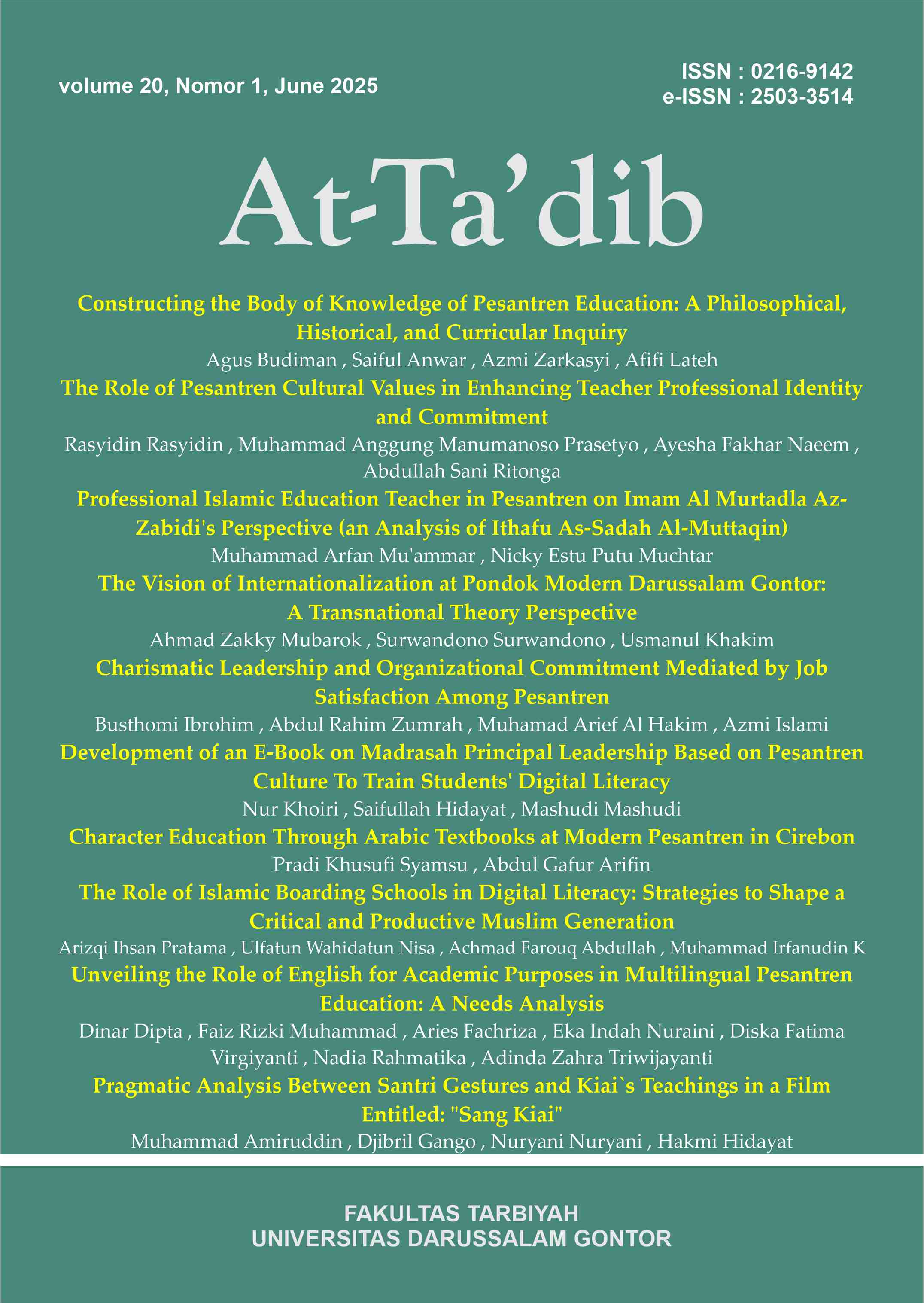
Constructing the Body of Knowledge of Pesantren Education: A Philosophical, Historical, and Curricular Inquiry
DOI:
https://doi.org/10.21111/at-tadib.v20i1.25Kata Kunci:
Body of Knowledge, Pesantren, Education, Philosophy, CurriculumAbstrak
Purpose - Pesantren education, as Indonesia’s oldest Islamic educational institution, holds a rich tradition of nurturing intellectually and spiritually grounded individuals. However, despite its significant historical and cultural role, pesantren education has lacked a formalized Body of Knowledge (BoK) that could support its academic development within higher education. This study aims to construct and map the BoK of pesantren education to provide a structured epistemological foundation for pesantren-based academic programs. Methods - This research adopts a qualitative library research methodology with analytical and interpretive approaches. Data were collected from classical Islamic texts and contemporary studies on pesantren and Islamic education, and were analyzed using inductive-comparative techniques grounded in Islamic epistemology and educational theory. Findings – The findings indicate that pesantren education is underpinned by an integrative epistemology that combines revelation (naqli), reason (‘aqli), and spiritual insight (‘irfani), and operates through a holistic and adaptive curriculum. The study identifies six key domains forming the BoK: Philosophy of Pesantren Education, Curriculum and Methodology, Leadership and Management, Socio-Anthropology, Innovation, and Classical Islamic Text Studies. Implications / limitations - This study’s main limitation lies in its conceptual nature, suggesting a need for empirical validation. Originality - lies in the systematic formulation of a pesantren education BoK an academic framework that had not been explicitly mapped before thus offering significant value for curriculum design and academic development in Islamic higher education.
Unduhan
Telah diserahkan
Diterbitkan
Cara Mengutip
Terbitan
Bagian
Lisensi
Hak Cipta (c) 2026 At-Ta'dib

Artikel ini berlisensiCreative Commons Attribution-NonCommercial-ShareAlike 4.0 International License.